Een Groter Gesprek – online conversation with Malcom Ferdinand (November 11)
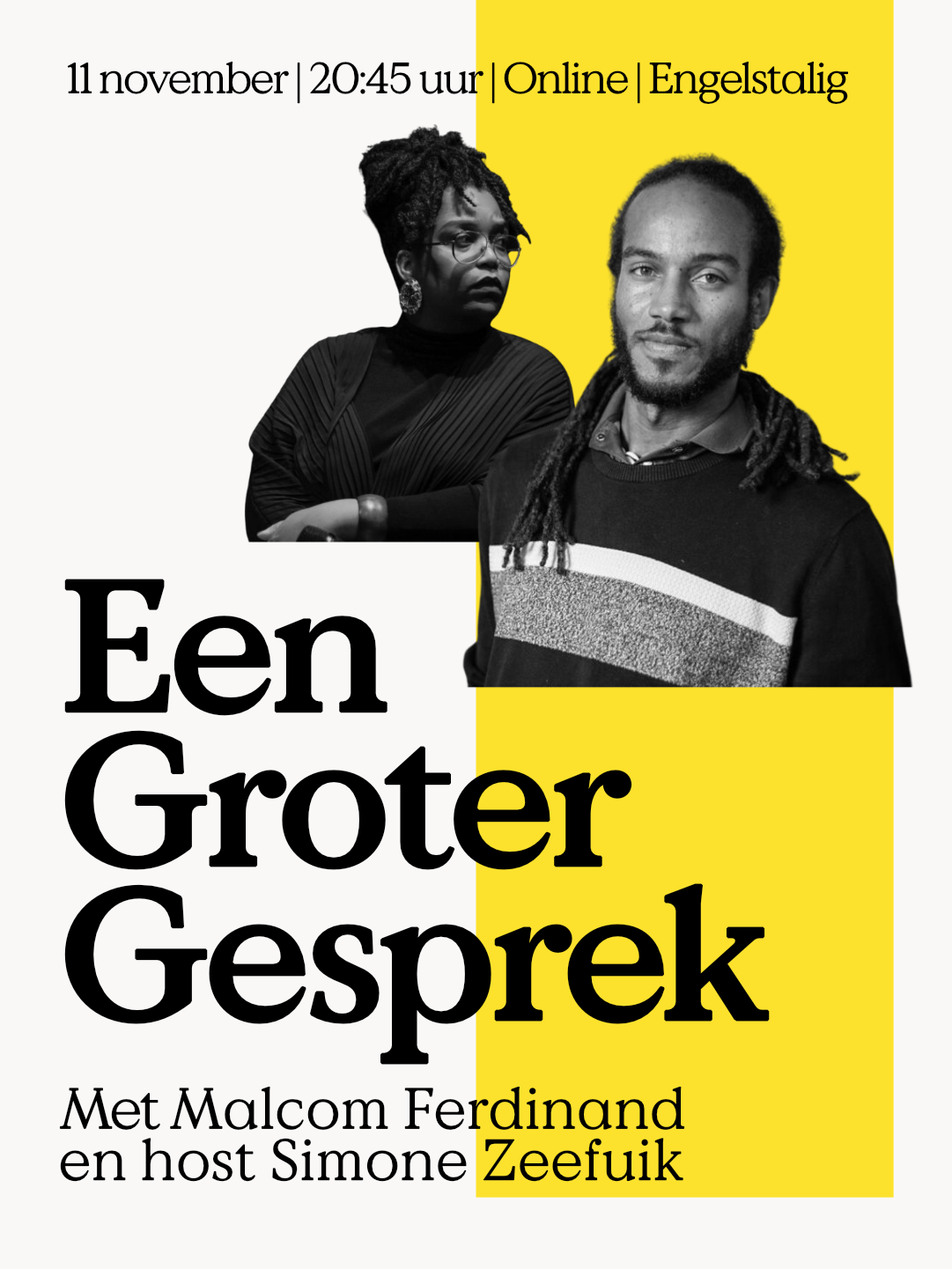
In her early research stages for the play Een Groter Verhaal, Romana Vrede asked me if I knew Malcom Ferdinand’s book ‘Decolonial Ecology – Thinking from the Caribbean World’. I did. And, her question made me realize it had been a moment since I spent some quality time with Ferdinand’s thoughts. Reading “… but all’s not lost, gentlemen. We just have to try to get to the eye of the storm.” reminded me of these delicious moments of feeling at home in a work. The books’ prologue opens with this quote from Aimé Césaire’s ‘A Tempest’, a work that helped shape my early understandings of theatre. Soft as I am, I was immediately in. The work lived up to it, tho’! ‘Decolonial Ecology…’ offers a fresh mix of research, prose, poetry, science, philosophy, reimagination and relearnings. Needless to say it’ll be my honour and pleasure to interview Malcom Ferdinand about this book plus his inspirations and writing process on Wednesday November 11, from 20.45h-21.45h (Amsterdam/Paris time). Our conversation is part of Bureau Vergezicht’s “Een Groter Gesprek (A Bigger Conversation)” program.
The program will take place online, via ZOOM, and it’s free to join. To join, please sign up here so I can send you the English version of the confirmation e-mail. This will include the ZOOM info and the program schedule. For our conversation it’s absolutely not necessary to have read Ferdinand’s book or to have seen Een Groter Verhaal beforehand. Below, you’ll find Bureau Vergezicht’s original flyer.
Malcom Ferdinand
Hailing from Martinique, Ferdinand is a Paris based researcher, ecological engineer and doctor in political philosophy. His work focuses on ecology from a decolonial, Caribbean perspective.
About “Een Groter Gesprek”
For their “Een Groter Gesprek” series Bureau Vergezicht highlights the works that influenced Romana Vrede, Anouk Nuyens and Rebekka de Wit as they wrote the script for the play “Een Groter Verhaal (A Bigger Story). This solo performance by Romana Vrede is co-produced by Bureau Vergezicht and Theater Rotterdam. Een Groter Verhaal will be on tour throughout the Netherlands until December 16.

Ajufo and Coel and Erivo and adaptations
London is always a good idea.
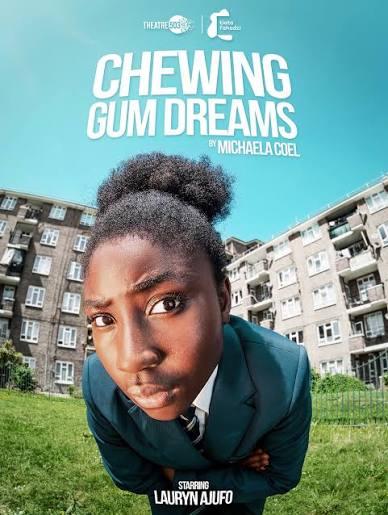
1. Chewing Gum Dreams
(seen on Wednesday September 23 at Theatre503, London)
Hopping on the Amsterdam-London train to see Chewing Gum Dreams at Theatre503 in London was the perfect way to start Autumn. And, to reload for what feels like the most packed season in the Dutch cultural agenda. Here, October to December will have you squinting and blinking at the same time. The Dutch theatre world doesn’t just need more works. It specifically needs more of this. More of this clever, fresh-fresh, high paced and very, very funny writing. Original, unapologetic, non-explanatory, free, razor-sharp writing. Michaela Coel, who wrote the script for Chewing Gum Dreams, is of course a genius with the pen. I’d love to hear/read more about her writing process ànd I’d love to learn more about the kind of reader she is.
For its initial run, Chewing Gum Dreams was described as ‘a one-woman play that recalls the last days of innocence before adulthood.’ Seeing it was a perfect night out for two NL-based theatre lovers who are tired of the ‘Destination: Explanation!’ and ‘Identity as the whooole storyline’ pieces we’re often flooded with. Chewing Gum Dreams offered us the fun and relaxation we were craving for.
Lauryn Ajufo was brilliant as Tracey. The ways in which she reminds us of Tracey without mimicking Michaela Coel are sublime. Her quickness, the way she goes back and forth between so many different characters that each have their own tone and pace? A joy to watch. This is CRAFT… all caps and a very deep bass. Salutes to director Anthony Simpson-Pike and to Yimei Zhao for the set design. We took it allll in and we very much enjoyed it.
2. Prima Facie
(seen on Tuesday October 13 and Saturday October 17 at the Royal Festival Hall during London Film Festival)
Black women’s co-signs are my favourite reason to go see an adaptation of an outer-canon classic. With ‘outer-canon’ classic I mean a work that’s “world” famous but is no longer or has never been part of my immediate frames of reference. This doesn’t always mean there are gaping zero’s worth of interest. I mean, sometimes… Mostly it just means that I haven’t invested in seeing or reading it. “Someday, maybe.” Just not right now. And certainly not in a way that puts me in the London Film Festival’s digital waiting line with 2441 people in front of me. But, when Cynthia Erivo is in it?! That 2441-people-line is exactly where you’ll find me. I might have even dressed up for it. Because when cousin Cyn stars in and executive produces a work… darling, that places Prima Facie on the top of my lists.
The film adaption of Suzie Miller’s play Prima Facie had its UK première on Tuesday October 20 at London’s Royal Festival Hall. Both the play and the film are about Tessa Ensler, a successful defence barrister (lawyer) who is painfully confronted by the laws she so fiercely believed in. Tessa Ensler is portrayed by… Cynthia Erivo.
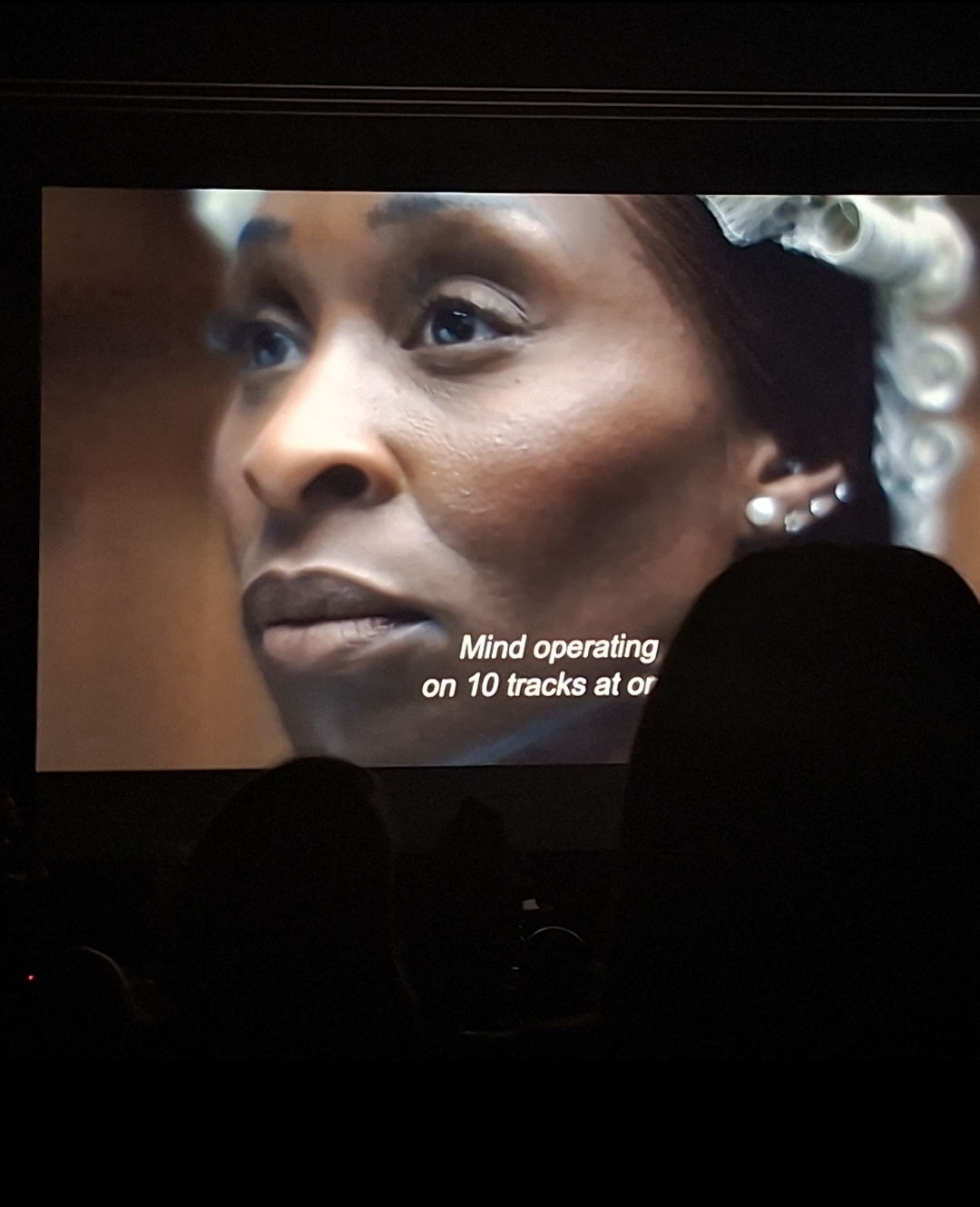
After a good three hours in the waiting list, I booked one of the last 15 tickets for the film. And, after Erivo’s BFI Screen Talk with Clara Amfo the evening before the première, I booked another ticket for a few days later. The way Erivo talked about it made it crystal clear: I’m going to want to see this twice. We were right. And when it comes to the Dutch cinema’s, I’ll watch it a dozen times more. What a gorgeous film. It left the entire Royal Festival Hall quiet-quiet. This film is breathtaking. The cinematography, the costumes, the music, the care invested in now portraying Tessa Ensler as a Black woman… with a Black family… Black routines… and Blackity Black armour.
I loved it so much I bought a special edition of Suzie Miller’s script. After my reading-and-rereading routine I’ll write about how I believe this film is a masterclass of how to turn a one-person-play into a film with multiple, prominent characters. That was my impression after only reading the first scenes and now, eyebrow-deep in my reading-and-rereading routine, it’s something I stand by. To be continues because… my goodness!
And, that thing they say… “Person1 is the Person2 of our time.” Darling, Cynthia Erivo is the Cynthia Erivo of our life. Of. Our. Life!! Awe-mazing.
The picture was snapped during the BFI Screen Talk. No idea why the person in front of me figured that this was the perfect moment to block my view of the screen. But, when closely paying attention, I can’t play around with my phone too much so I guess this is the picture we’ve got.

love – The Gloria Wekker Reader
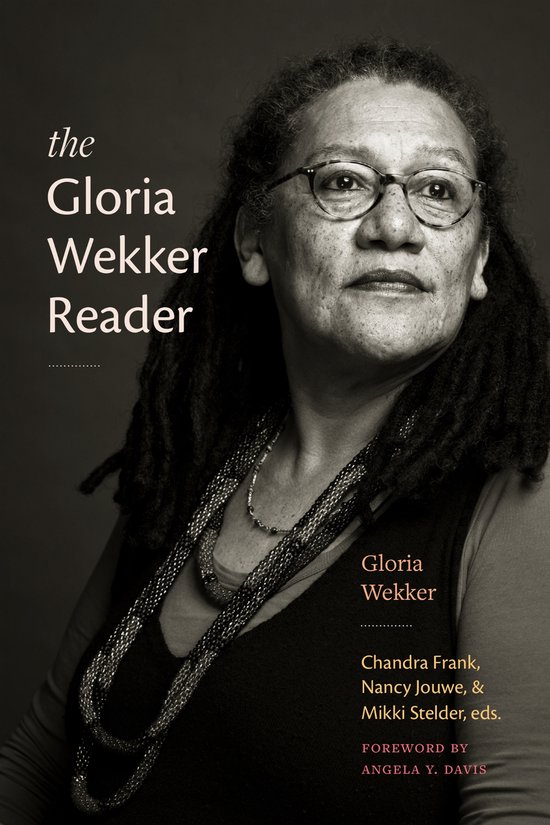
“The route we are about to take is an interdisciplinary one, but with feminist and postcolonial signposting.” These words, as she spoke them at her oration on April 19 2002, aged perfectly into a description of this gathering, happening a good 24 years later. On June 12, in the University of Amsterdam’s packed-packed auditorium, we celebrated the release of the Gloria Wekker Reader. It was lush. And rich. And warm. So loving. It perfectly matched this collection of essays that are so poetic, smart-smart, witty, courageous and free.
Chandra Frank, Nancy Jouwe and Mikki Stelder -who edited the Gloria Wekker- are an editorial ànd programming dream team. What an evening! Nawal Mustafa, Sruti Bala, Sarah Bracke and Alana Helberg-Proctor read their reflections on the reader, Babs Gons recited four of professor Wekker’s poems. When Domenica Ghidei Biidu, Saffa Khalil and Nella Rebero received the first three copies of the Reader, not a tissue or napkin remained unused. Hearing professor Wekker say why wanted to celebrate each of them in this symbolic moment? A lovin’. A delicious softness of the kind only we can extend to each other.
What an honour that she invited me to host the launch of her Reader. While preparing for the launch, my copy of the Reader nearly doubled in size. It is now packed with bookmarks. If you’re studying gender, Queerness, Blackness, feminist movements, sexual cultures in Afro-Surinamese communities and/or colonial mentalities in the Netherlands… this is a must read. As always: Support your local and independent bookstores like Bijlmer Bookstore (Amsterdam), Savannah Bay (Utrecht) and Base Bookspace (Rotterdam).


You must be logged in to post a comment.