Upcoming events: Billie Holiday, Project Wiaspora & #BPTKids
This year, fast-fast and slow as it has been, is coming to an end. The Blacker Blackness classes will continue until the Winter break but I’m wrapping up my Bijlmer Parktheater activities of this year on Sunday December 5. That morning, from 11.00h-13.00h, our awe-mazing head of PR & marketing Kimberley Piqué, the good Sista’s from the Bijlmer Bookstore and I are co-hosting a kid’s event in the foyer of Bijlmer Parktheater: #BPTKids . More info will follow soon but when I tell you it will be hosted by Jennifer Muntslag and José Montoya, you already know the kids (age 2-7) will love it.
November events
1. Thursday 18, Bijlmer Parktheater: Live recording of two Project Wiaspora-episodes
Event text (as written for Bijlmer Parktheater): As part of their Project Wiaspora podcast, initiators Simone Zeefuik and Richard Kofi, financially supported by the Stimuleringsfonds, developed a new series: Wiasporan Proverbs. These proverbs consist of six truths, four of which are recorded live in the main room of the house where Zeefuik and Kofi both work as programmers: Bijlmer Parktheater. Each episode is a mix of conversations and performances. The two Wiasporan Truths they’ll record with their guests on Thursday, November 18, are “What’s the scenario?” and “What’s the future tense of being Afro-European?”. “What’s the scenario?” is about how we’d like to see the representation of NL-based, Afrodiasporic communities in films and plays. In the episode “Past, present… What’s the future tense of being Afro-European” Kofi, Zeefuik they will visualize the future of Afrodiasporic communities in Europe. For this Wiasporan Truth, they’ll focus on national institutes and independent initiatives.
Featuring: Ira Kip, Lyse Ishimwe and Adéọlá Adérè̩mí.
Time: 20:00h-22:00h
Click here to purchase your ticket(s).

2. Saturday 20: Panel about Billie Holiday & the film The United States vs. Billie Holiday
“Me, personally… my opening scene would start with a closeup of her right hand. We see it holding a dangling cigarette, its top marked vaguely by red lipstick, and a piece of paper. We can’t read the handwriting but we can make out that the text comes with notes and marks. It’s quiet. Quiet as the camera slowly zooms out and she lays the paper down on something. Perhaps a table, probably a chair.” On my Instagram, I posted part of my reimaginations of this film that I have major issues with: The United States vs. Billie Holiday. The movie centers around the song Strange Fruit and how performing it, resulted in an institutionally racist standoff between Billie Holiday and the U.S.A. What I truly, and when I tell you deeply, am looking forward to, is talking about Billie Holiday with three of my favourite folks: Ira Kip, Aïda Sium and Tracian Meikle. We’ll do so on Saturday November 20 at Rotterdam’s LantarenVenster cinema. We’ll talk about our love for Billie Holiday, the choices we would have made, the urgency of unlearning certain gazes and Hollywood’s unfaced challenges of properly portraying this Icon. Our conversation will be in English.
Location: LantarenVenster (address: Otto Reuchlinweg 996, 3072 MD Rotterdam).
Time: 14.00h-17.30h.
Click here to purchase your ticket(s).
Please note: Your ticket is for the film screening and the panel. If you have a Cineville card, please choose the “Reserveren”-option. There, you can select your free ticket.
This event is a co-production of HipHopHuis, Bijlmer Parktheater, Recognition and LantarenVenster.
Upcoming events: Christian Yav, Reinel Bakole and Billie Holiday
Let’s wrap up the year with some wholesome goodness, shall we? As a programmer for Amsterdam’s Bijlmer Parktheater, I’m (co-)hosting the following events on Thursday Nov. 4 and Saturday Nov. 20:
– Thursday Nov. 4 at Bijlmer Parktheater: the dance performance Movements of Soul by dancer, model and choreographer Christian Yav and multidisciplinary Afro-Soul vocalist Reinel Bakole. After the show, I’ll be the moderator for a 30 minute conversation between them and the audience. This conversation will be in English.
For an impression of the work of Christian Yav and Reinel Bakole, please check the video’s below. Click here to buy tickets.

– Saturday Nov. 20 at LantarenVenster (cinema in Rotterdam): Conversation about Billie Holiday and the film “The United States vs. Billie Holiday. I’m co-hosting this event with Lyse Ishimwe (Recognition, Bruxelles), Aruna Vermeulen (HipHopHuis, Rotterdam). Click here to buy tickets.
Our event text:
“(…) the image that [Billie Holiday] acquired in U.S. popular culture relies on biographical information about Holiday’s personal life at the expense of acknowledging her role as a cultural producer, which is, after all, the reason for her enduring importance. (…) While [Billie Holiday] did not engage in extended political analyses, she never attempted to conceal her loyalties. “I’m a race woman,” she proclaimed on numerous occasions. According to Josh White, who became her friend after an initial collision over his performance of “Strange Fruit,” she had more thought for humanity and was more race-conscious than people thought.
Billie Holiday never witnessed a lynching firsthand. The fictionalized scene in the film Lady Sings the Blues, in which she sees a black man’s body swinging from a tree. Is a gross oversimplification of the artistic process. This scene suggests that Holiday could only do justice to the song if she had experienced a lynching firsthand. The film dismisses the connections between lynching -one extreme of racism- and the daily routines of discrimination which in some way affect every African American.”
– Angela Davis in her book Blues Legacies and Black Feminism
29 years after Diana Ross played the lead in the legendary film Lady Sings The Blues, it is singer Andra Day who stars as Lady Day in the latest film The United States vs. Billie Holiday. The movie centers around the song Strange Fruit and how performing it, resulted in an institutionally racist standoff between Billie Holiday and the U.S.A.
On Saturday November 20, Lyse Ishimwe (Recognition, Bruxelles), Aruna Vermeulen (HipHopHuis, Rotterdam) and Simone Zeefuik (Bijlmer Parktheater, Amsterdam Bijlmer) will screen The United States vs. Billie Holiday in the Rotterdam cinema LantarenVenster. After the screening, they’ll host a panel about the portrayal of Billie Holiday in this film. Three movie nerds hailing from Bijlmer and Rotterdam will have a conversation centered around Lady Day and Hollywood’s unfaced challenges of properly portraying this Icon. The film received very mixed reviews and Ishimwe, Vermeulen and Zeefuik decided it’s a good occasion to gather ourselves and discuss.
The conversation will be in English.
The line up will be announced on our Instagram pages on Monday November 1.
Candyman-event: screening and panel in Rotterdam

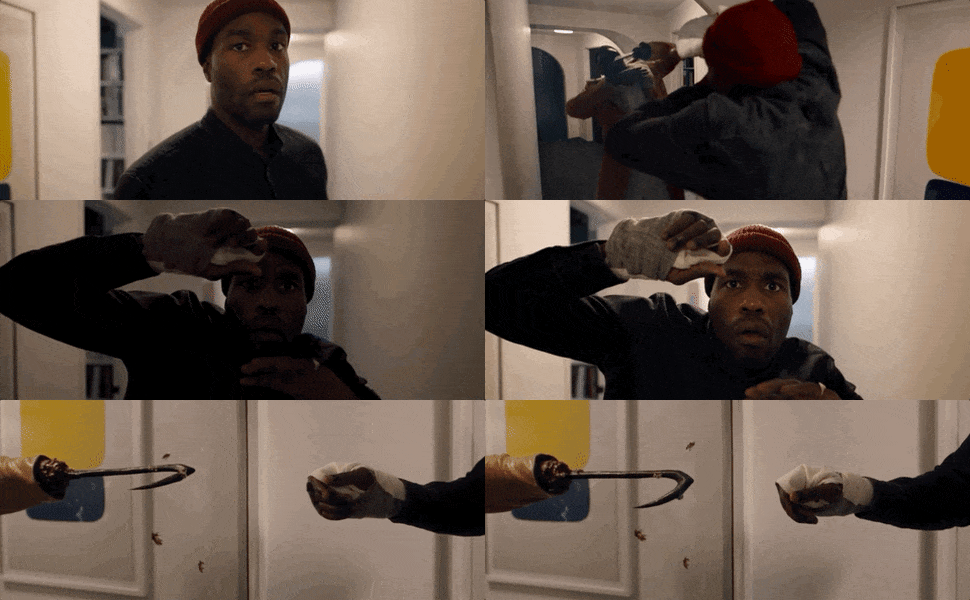
Nia DaCosta (pictured here): “Throughout the making of the film, the thing that I always came back to was the truth that was at the center of the story of Candyman. In the real world, we create monsters of men all the time. People are murdered, they become either saints or they’re vilified. Throughout the last year and a half, it was always coming back to that truth. Horror is a very effective tool when it comes to telling stories about things that impact us on a social level. The very function of it is to make you uncomfortable and I think if that discomfort is attached to explorations of race or gender, you have to then reconcile your feelings about race and gender.”
The basics
Date and time: Sunday September 19, 16:00h-18:45h.
Moderator: Tracian Meikle.
Panelists: Lyse Ishimwe Nsengiyumva, Adison dos Reis, Cye Wong-Loi-Sing and myself.
Ticket link: https://www.cineramabios.nl/film/3318 . Our event is the 16:00h screening (and not the 16:45h screening).
Please note: This conversation will be in English. You don’t need proof of vaccination or a negative COVID-test to attend.
Organized by: Lyse Ishimwe Nsengiyumva (Recognition, Bruxelles), Aruna Vermeulen (HipHopHuis) and myself (as a programmer for Amsterdam-Bijlmer’s Bijlmer Parktheater).
About the event
26 years after the original was released, Jordan Peele signs on as a producer for the remake of one of the Blackest horror classics Hollywood gave us: Candyman. In November of that same year, 2018, it was confirmed that Nia DaCosta would direct the film. When that first trailer with the haunting remix of Destiny’s Child’s “Say My Name” was spread all over our timelines, it was clear that this film would rightfully demand our full attention and excitement. And then… the pandemic hit.
Fast forward to now. Sunday September 19 in Rotterdam, to be exact. Lyse Ishimwe Nsengiyumva (Recognition), Aruna Vermeulen (HipHopHuis) and I (as a programmer for Bijlmer Parktheater) teamed up to co-host a Candyman-event in Rotterdam. We rented a space at Cinerama, the Rotterdam based cinema where the event will take place. After the screening there will be an hour long panel about the film. During this talk, we’ll focus on the artistic brilliance of the film, its pro-Black imagination, the social commentary-references that stood out to us and the place it holds within the genre of pro-Black horror. The conversation will be in English.
Son of Baldwin: “It’s like author Brit Bennet said, a lot of these films being made in the wake and spirit of Get Out fail to do the transformative work of making this situations something other than trauma porn. If you’re going to use a racially traumatic paradigm as the basis of horror cinema, I believe you have to do something artistic to transform it into a considered, thoughtful morality play or cautionary tale that goes beyond simply torturing the Black characters for kicks, sh*ts, giggles and the white gaze. And you have to do that artistic work because the racially traumatic paradigm is ALREADY HORROR IN REAL LIFE.”
 laZeefuik
You must be logged in to post a comment.