Category Archives: Imagery and representation
To topple an “ally”
Her agreeing hhhmm sounded hollow, almost fading. She discretely rushed it past my point towards hers. “Sure. I mean, yes. Of course…” She cupped her drink the way one holds their breath right before uttering a word that completely dismisses the understanding they claim to have. One last sip, for emphasis. “But, the most important thing is that this city finally gets its first statue of a Black person!” Her exclamation point presented itself as an empty glass firmly planted on the table under her now crossed arms and my air piano-playing fingers. Undistracted from the Monk tune I was tapping, I informed her that, in the process of decolonizing, one doesn’t unpack justice in one single peel. To say it doesn’t matter who sculpts a statue that represents Blackness is to claim that it’s not important who tells our stories. It also suggests, and perhaps this troubles me most, that if white artists portray Blackness in their work they no longer have to burden themselves with the moral obligation to not just make space… but perhaps, and ever so silent, sometimes leave the room altogether.
I was reminded of this and many similar conversations about statues in Dutch public spaces when my Instagram and Twitter timelines buzzed with the news about Bristol’s latest monument. On the same spot where, days earlier, the image of a colonial terrorist was snatched off its pedestal there was now a towering image of a Black woman. When this first came to my attention, I hoped the new statue was the work of the Black British artist Thomas J. Price. Before I clicked on the post that would reveal the image of the statue, I took a moment. I took one of those “please, pleaaase…”-soaked moments where, before you open that e-mail or rip the wrapping paper, you hope that a dense enough manifestation of your desires will somehow affect what you’re about to see. I hoped for Price because I longed for the freedom he grants the realities he monumentalizes, I longed for a liberation from the gaze of artists whose imagination of our strength limits itself to the spectacle of our resistance. I wanted to see a woman who, if only for a split second, didn’t have to heavy her bones with the need to convince someone of what she already knows.
As I enlarged the image between my fingers I figured that this wasn’t the work of Price. Which, for me, would have been fine if the magnitude of the momentum, the impact of having the image of Black Lives Matter-activist Jen Reid replace that of a colonial terrorist, was at least held by the hands of a Black sculptor. It needed to have been a Black sculptor. The attention that is now given to a white artist, whose understanding of our liberation movement is limited to the calculation of how it can serve him, would have moved mountains for Black British artists.
Those who consider the claiming of space a “Survival of the fittest”-type of issue, will probably claim that this is simply a matter of whoever comes first, is first. Simple as that. In situations like this, I personally care nuffin’ about being first. It’s easy to be first when the only thing at risk is the relevance of your portfolio and when you don’t have to worry about the financial and material means to pull off a stunt like this.
A decolonial appreciation for and solidarity with Black people would have never resulted in the vulgar hijacking that took place. I hope more of us take the time to unpack what this moment meant and what future attempts like this will mean. What it means when white artists centre their work around Black people fighting for liberation. What it means when white artists document a pain, an exhaustion, a refusal, a rejection or a demand they will never fully understand and take these images to further carve out their names. What it means when white photographers at the Black Lives Matter protests continue to argue with Black people who don’t want their picture taken. What it means when white artists consider the memorialization of an important moment in the histories of Blackness and proclaim that it will be their honour to be The First to do this.
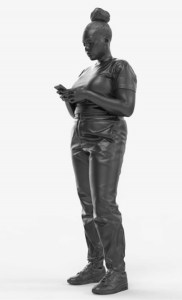 And I truly hope that the analyses of what we unpack create spaces for (re)imaginations that centre decolonial Black artists who craft images that are reflections and not interpretations of us. We owe this to ourselves, to who we know we are. And yes, we owe this to artists like Thomas J. Price who, in very clear terms, speak out against colonial hijackings ánd, to not add to our burdens, urge Black artists to not answer opportunism with haste.
(This picture is an example of Thomas J. Price’s work. I borrowed the image above from his Instagram.)
Upcoming events
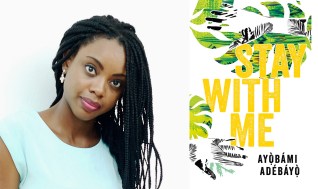
Sunday June 16: Ayọ̀bámi Adébáyọ̀ – lecture and conversation
In collaboration with Bijlmer Bookstore, the Amsterdam Black Women collective and Lola Shoneyin (Aké Arts and Book Festival) we’re welcoming Ayọ̀bámi Adébáyọ̀, the author of Stay With Me, to the Bijlmer. On Sunday June 16 she, moderator Tracian Meikle and an audience of max. 40 people will discuss her book that won prizes like The Future Awards Africa Prize for Arts and Culture and many, many others.
Moderator: Tracian Meikle, co-founder of the Amsterdam Black Women collective.
Time and location: 16h – 18h, Bijlmer Bookstore (address: Hettenheuvelweg 16, Amsterdam Southeast). Doors open at 15:30h.
Click here to buy tickets.
 Saturday June 22: Wiaspora podcast as part of the Xenogenesis exhibition
Live recording of our podcast centred around Afro- and African Futurism*.
Theme: Creolizing the canon
Hosts: Richard Kofi and moi.
Guests: Munganyende Hélène Christelle, Pelumi Adejumo, Naomie Pieter and Rose Sarpong.
Language: Dutch.
Time and location: 15h-17h, Van Abbemuseum (Eindhoven)
Free entrance!
* Term borrowed from the genius Nnedi Okorafor.
 Sunday June 23: Panashe Chigumadzi – lecture and conversation
On Sunday June 23 novelist and essayist Panashe Chigumadzi is coming to Bijlmer Parktheater to read from and discuss her work. Her debut novel Sweet Medicine (Blackbird Books, 2015) won the 2016 K. Sello Duiker Literary Award. Her second book, These Bones Will Rise Again, a reflection on Robert Mugabe’s ouster, was published in June 2018 by the Indigo Press. A columnist for The New York Times, and contributing editor of the Johannesburg Review of Books, her work has featured in titles including The Guardian, Chimurenga, Africa is A Country, Transition, Washington Post and Die Ziet.
Moderator: Tracian Meikle, co-founder of the Amsterdam Black Women collective.
Time and location: 19h-21h, Bijlmer Parktheater (Amsterdam).
Click here to buy tickets.
 Saturday June 29: Wiaspora podcast as part of the Xenogenesis exhibition
Live recording of our podcast centred around Afro- and African Futurism*.
Theme: Afrofuturism and African Futurism.
Hosts: Richard Kofi and moi.
Guests: Ola Hassanain, Stephanie Archangel, Veronique Efomi and Planet Airich.
Language: English.
Time and location: 15h-17h, Van Abbemuseum (Eindhoven)
Free entrance!
* Term borrowed from the genius Nnedi Okorafor.
Saturday July 6: Wiaspora podcast as part of the Xenogenesis exhibition
Live recording of our podcast centred around Afro- and African Futurism*.
Theme: Self care
Hosts: Richard Kofi and moi.
Guests: Glenn Helberg, Otion and Amal Alhaag.
Language: Dutch.
Time and location: 15h-17h, Van Abbemuseum (Eindhoven)
Free entrance!
* Term borrowed from the genius Nnedi Okorafor.
Friday Oct. 5 – Black Magic Woman event
From the best hashtags for the most needed social justice campaigns to looking like we invented every single colour, from writing books and articles about institutionalized anti-Blackness to bringing you the best Twitter threads with the deepest breakdowns and memes… we, as Black women, wrote our names all over your entire year. Life, even. Again. We are magic when taking over the theatres, universities, book charts, Youtube playlists and museums but best believe that we are equally magical when we rest, indulge in Self Care and/or say “No.” There’s magic in our work but, and this is perhaps more important, there’s work behind our magic. It’s more than ‘talent’ and ‘having a nose for it’… it’s expertise. It’s not a ‘head start in the race to be cool’, it’s a deep-rooted (self)love for that what makes us us and loving it before the mainstream catches on. We must praise each other more. Not just when they see us but long before that. Not just when what we do shows up on that generalized radar of acknowledgements. Waaay before that. At the root, from the moment we see ourselves and, but also in, each other.
With that in mind, my dear colleague Bahghi Yemane and I turned our “More celebrations!”-resolution into a program: the Black Magic Woman intro event. Black Magic Woman is an annual festival that started in 1995 and it was as great as the title predicts. The last few years it slimmed down significantly, some years not even taking place at all. It has been one of my long-time dreams to bring it back in a way that matches the memories that, with regards to events, hold a top position in the highlights of my late teens. I’m excited to report that I’ve been granted the honour of organizing the 2019-edition of the festival but that’s a lot of months from now and to hold back on celebrating Blackness… in this economy? I. Think. Not.
So, the festival-festival will take place in 2019 but on Friday October 5, we’re hosting a pre-event at Amsterdam’s Bijlmer Parktheater. There will be two panels:
Panel 1 (in Dutch) – Representation in film and fashion with panellists Grâce Ndjako, Janice Deul, Rowan Blijd and Tosca Vrede. Host: Bēylula Yosef. We’ll talk about:
– #BennieBeige, Rowan Blijd’s campaign that urged Dutch lingerie brands to rethink ‘nude’ as always being 11 shades of beige.
– #DiversityRules , Janice Deul’s platform that focuses on diversity with regards (but not limited) to magazine covers, fashion shows and advertisement.
– “Noire n’est pas mon métier” (Black is not my job), a movement where Black, French actresses protested against misogynoir and other forms of anti-Blackness in French cinema. Grâce Ndjako will give us a breakdown. The picture of above was taking during part of the protest.
– With Tosca Vrede, one of the Black Magic Girlz-coordinators we’ll talk about how all this impacts the lives and minds of Black, teenage girls.
Panel 2 (in English) – Representation in literature with panellists Sarah Ozo-Irabor (Books&Rhymes, (co-founder of Not Another Book podcast), Bēylula Yosef (co-initiator of Afrispectives) and Yomi Adegoke (co-author of Slay In Your Lane). Host: Marly Pierre-Louis.
During this panel we’ll discuss the recently released books and other bundles of stories that made us feel represented.
Wednesday, Bahghi and I will announce the third part of the program and we’ll do so on our Facebook event page. Please note that there’ll be a break between the 1st and the 2nd panel so people who don’t speak Dutch can also properly enter the room.
Basic event info
Date: Friday October 5
Time: From 20.00h until 22.00h.
Location: Bijlmer Parktheater (address: Anton de Komplein 240, 1102 DR Amsterdam)
Tickets: €5 and you can buy them here.
Hashtag: #BlackMagicWomanFest
 laZeefuik
You must be logged in to post a comment.